Why AI Chatbots Are a Business Essential in 2026
AI chatbots have evolved from frustrating script-based tools to intelligent conversational agents that resolve 60-80% of customer inquiries without human escalation. In 2026, they are the most accessible entry point for businesses beginning their AI automation journey.
The numbers tell the story: businesses with AI chatbots report 85% faster first-response times, 35% reduction in support costs, and 24/7 availability that customers increasingly expect. With implementation costs starting at $2,000-$8,000 and deployment timelines of 5-7 business days, the ROI calculation is straightforward.
Step 1: Define Your Chatbot Scope
The most common mistake in chatbot implementation is trying to do too much at once. Start by identifying your highest-volume, most repetitive customer inquiries. These are your quick wins.
For most businesses, the top use cases are: answering FAQs (product info, pricing, hours), order status and tracking, appointment scheduling, basic troubleshooting, and lead qualification. A chatbot handling just these five categories can deflect 40-60% of support tickets immediately.
Document your current support volume by category. If you handle 500 tickets per month and 60% are FAQ-type questions, that is 300 tickets your chatbot can handle — saving roughly 75-100 hours of agent time per month.
Step 2: Choose the Right Platform
Your chatbot platform choice depends on three factors: where your customers interact with you (website, WhatsApp, social media, email), what systems you need to integrate with (CRM, helpdesk, e-commerce), and your compliance requirements.
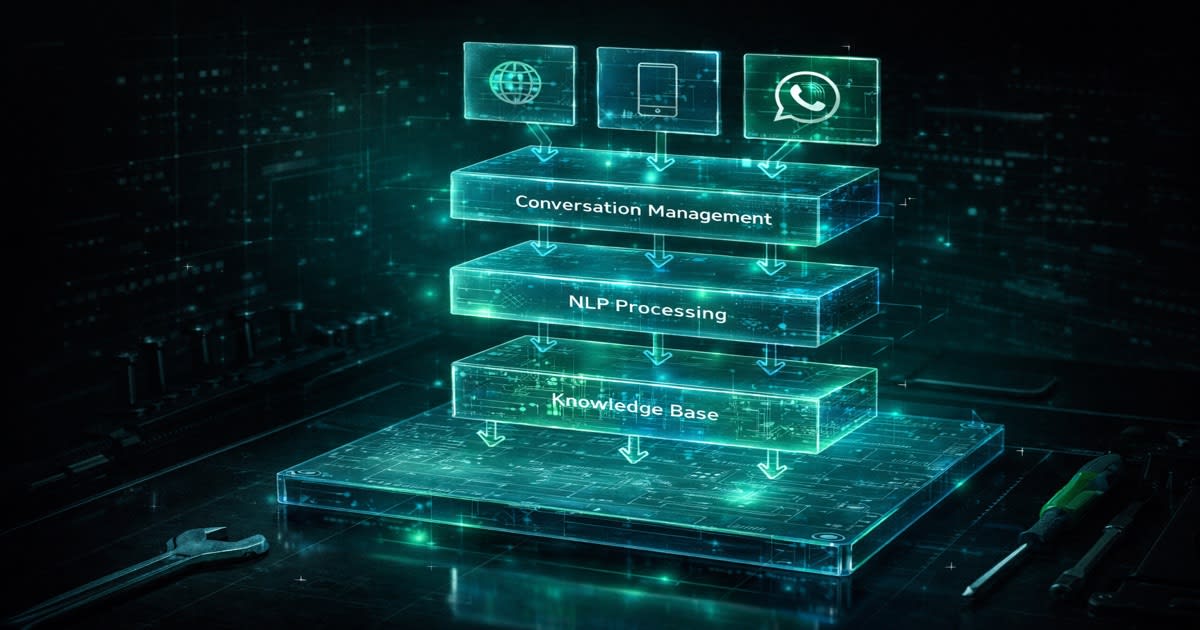
For website-first businesses, embedded chat widgets with AI backends are the standard approach. For businesses with heavy messaging app traffic, platforms like WhatsApp Business API with AI integration work better. Multi-channel businesses need a unified AI layer that routes conversations across platforms.
At HumansAI, we evaluate your specific channel mix and recommend the architecture that gives you the best coverage with the least complexity.
Step 3: Train and Deploy
Modern AI chatbots do not require months of training data collection. They learn from your existing documentation: FAQ pages, knowledge base articles, product descriptions, and past support conversations.
The deployment process typically follows this timeline: Days 1-2 for knowledge ingestion and initial configuration, Days 3-4 for testing and refinement with real conversation scenarios, and Days 5-7 for staged rollout starting with a percentage of traffic.
Critical: always deploy with a human handoff mechanism. Even the best chatbot encounters edge cases. The goal is not to eliminate human support but to let your team focus on complex, high-value conversations.
Step 4: Measure and Optimize
Track these metrics from day one: deflection rate (percentage of conversations resolved without human handoff), customer satisfaction score (CSAT) for chatbot interactions, average resolution time, and escalation patterns.
Most chatbots improve significantly in the first 30 days as they encounter real-world conversations. Weekly reviews of escalated conversations reveal gaps in the chatbot knowledge base that can be quickly addressed.
Well-optimized chatbots achieve 70-80% deflection rates within 60 days of deployment. At that level, a business handling 500 monthly tickets reduces agent workload by 350-400 tickets per month.