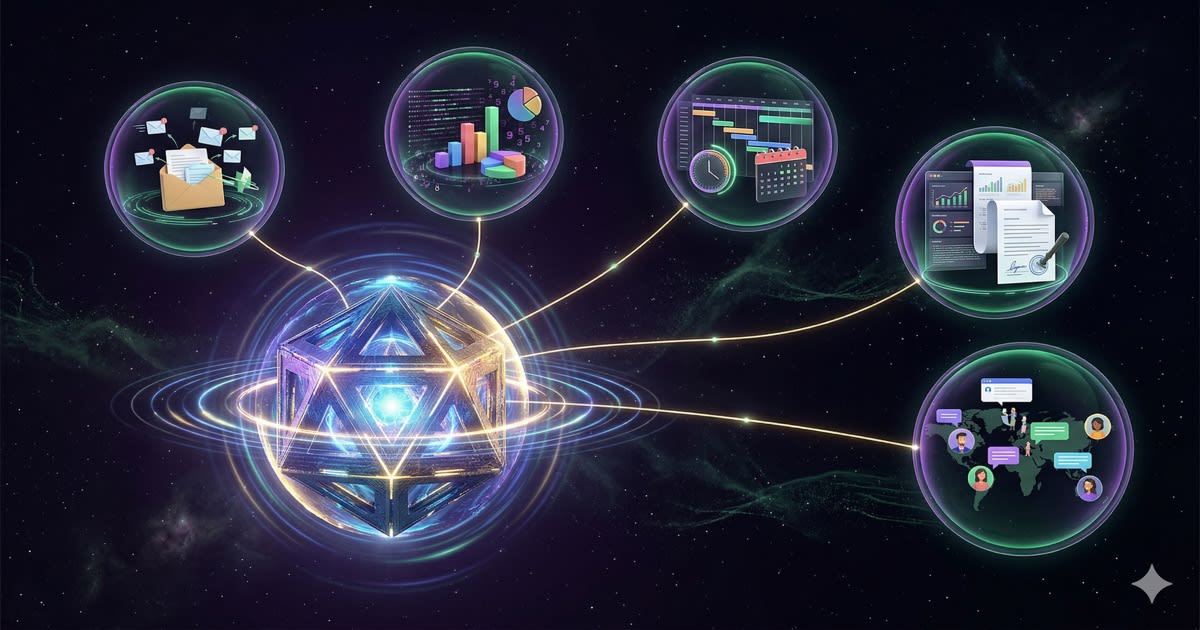
What Is Agentic AI?
Agentic AI is software that can plan a multi-step task, execute each step, evaluate results, and adjust its approach without waiting for a human to click "next." That is the core difference from the chatbots and copilots most businesses use today. A chatbot answers one question. An agentic system takes a goal like "find three suppliers who meet our compliance requirements, compare pricing, and draft a recommendation memo" and does all of it.
The technology sits on top of large language models but adds a reasoning-and-action loop. The agent breaks a goal into sub-tasks, calls external tools (databases, APIs, email), checks whether each step succeeded, and retries or reroutes when something fails. Gartner projects that 40% of enterprise applications will have agentic AI built in by the end of 2026, up from less than 5% in 2025. That is not a gradual adoption curve. It is a cliff.
How Agentic AI Differs from Traditional Automation
Traditional automation follows a script. Robotic process automation (RPA) clicks the same buttons in the same order every time. If a form field moves or a new exception appears, it breaks. Rule-based chatbots match keywords to canned responses. They work until they don't.
Agentic AI operates on goals, not scripts. Hand it an objective and it figures out the steps. When it encounters something unexpected, it reasons about what to do next instead of throwing an error. This is why 78% of executives surveyed by Accenture say they will need to reinvent their operating models for agentic AI. The change is structural, not incremental.
The practical result: tasks that required human judgment at every decision point can now run autonomously. Invoice processing that needed a person to handle exceptions. Customer onboarding that stalled whenever a document was missing. Sales pipelines where leads went cold because nobody followed up on time. These are the processes agentic AI handles well, because they are goal-oriented, multi-step, and full of small decisions.
Real Business Use Cases in 2026
Customer support is the most mature use case. Agentic systems now resolve 60-80% of support tickets by pulling order data, checking policies, issuing refunds, and sending follow-ups without escalation. They handle the entire resolution, not just the first reply.
Finance teams are deploying agents for accounts payable. An agent receives an invoice, extracts line items, matches them against purchase orders, flags discrepancies, routes approvals, and schedules payment. Processing time drops from 12 minutes per invoice to under 45 seconds, with error rates falling from 4.2% to 0.3%.
Sales operations use agentic AI to qualify leads, personalize outreach sequences, schedule meetings, and update CRM records. One mid-market SaaS company reported that their sales team reclaimed 15 hours per week per rep after deploying an agent to handle prospecting workflows.
HR departments are automating employee onboarding with agents that coordinate document collection, system provisioning, training schedules, and compliance checks across multiple platforms. What used to take 3-5 days of coordinator time per new hire now runs in hours.
The Market Is Moving Fast — and Unevenly
The enterprise agentic AI market was $1.5 billion in 2025. It is projected to reach $41.8 billion by 2030, a 175% compound annual growth rate. And 88% of senior leaders plan to increase their AI budgets in 2026, according to a Foundry survey.
But there is a gap between experimentation and production. Two-thirds of organizations have experimented with AI agents. Only one in four has scaled them to production use. The other three-quarters are stuck in pilots, proofs of concept, and "innovation labs" that produce demos but not deployed systems.
The bottleneck is rarely the technology. It is governance, integration, and organizational readiness. Companies that move agents from pilot to production share common traits: they pick a specific, measurable workflow (not "AI transformation"), they assign clear ownership, and they build evaluation frameworks before deployment. The ones that stall usually tried to boil the ocean.
Risks, Governance, and What Can Go Wrong
Agentic AI makes decisions. That means it can make bad ones. An agent processing refunds without proper guardrails could approve fraudulent claims. An agent sending customer communications could share inaccurate information. An agent with database write access could corrupt records.
Governance for agentic AI requires three things. First, scope constraints: define exactly what the agent can and cannot do, which systems it can access, and what dollar thresholds require human approval. Second, audit trails: every action the agent takes should be logged with its reasoning. Third, evaluation loops: measure accuracy, error rates, and edge case handling on an ongoing basis, not just at deployment.
Compliance adds another layer. In the US, HIPAA and SOC 2 requirements apply to any agent handling health data or operating within certified infrastructure. The UK has AI-specific guidance from the ICO. Australia's Privacy Act applies to automated decision-making. The UAE's DIFC and ADGM frameworks govern AI in financial services. New Zealand's Privacy Act 2020 covers automated processing of personal information. Any agentic deployment needs to account for the regulatory environment where it operates.
How to Get Started Without Overcommitting
Pick one workflow. Not your most complex one — your most repetitive one. The one where your team spends hours on tasks that follow a predictable pattern but require enough judgment that a simple script cannot handle them. Customer support triage, invoice processing, lead qualification, and appointment scheduling are common starting points.
Map the current process: how many steps, what decisions get made, where does it break down, and what does success look like? This becomes your agent specification and your evaluation baseline.
Start with a constrained deployment. Give the agent read access but require human approval for actions above a certain threshold. Monitor closely for the first 30 days. Expand scope as confidence grows.
Most implementations at HumansAI go from initial scoping to production deployment in 3-8 weeks, depending on the complexity of integrations and compliance requirements. The cost is a fraction of what full RPA implementations used to run, because agents adapt to process variations instead of requiring every exception to be manually programmed.
The question for most businesses is not whether agentic AI will change their operations. It is whether they will be the ones deploying it or the ones competing against companies that did.