The Real Cost Ranges, No Hedging
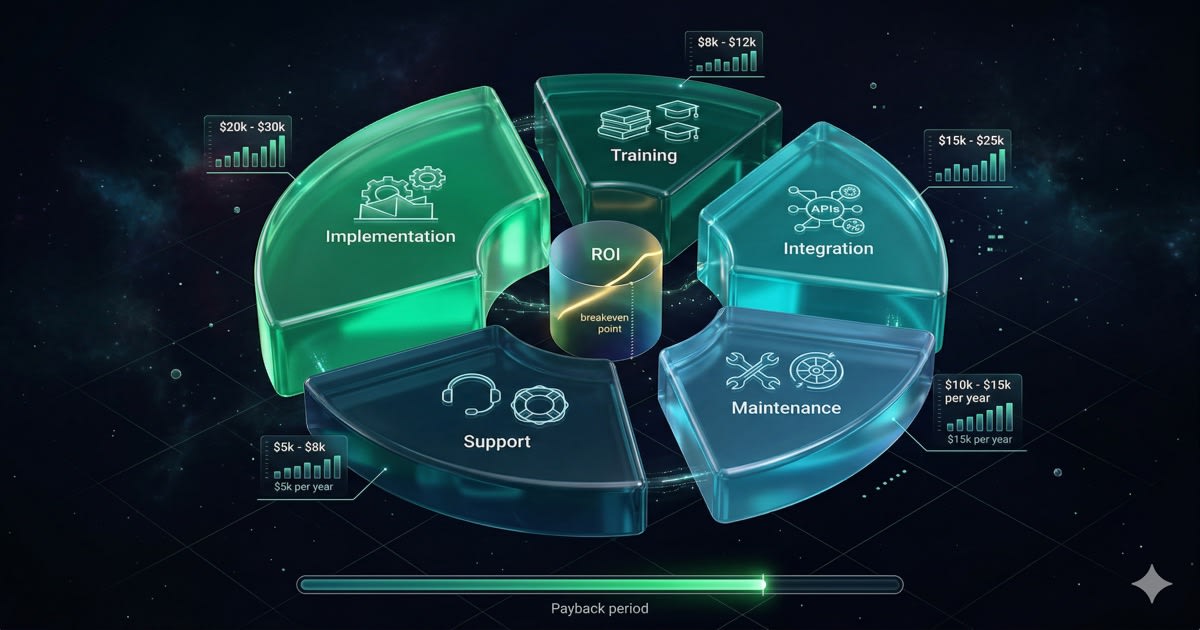
AI automation in 2026 falls into three price brackets. A chatbot or single-channel support bot costs $2,000 to $8,000 to implement, with $200-$500 per month in ongoing API and hosting fees. Workflow automation that connects multiple systems — think lead routing, invoice processing, or employee onboarding sequences — runs $5,000 to $25,000 depending on how many integrations you need. Enterprise deployments with custom model training, multi-department rollouts, and dedicated infrastructure land between $25,000 and $100,000 or more.
Those ranges have dropped roughly 40% since 2024, according to Gartner's January 2026 AI spending report. Two years ago, a basic chatbot project started at $15,000 minimum because you needed a specialized NLP team. Today, foundation model APIs from OpenAI, Anthropic, and Google handle the heavy lifting. The labor cost shifted from building AI to integrating AI with your existing stack.
Here is a specific example. A 50-person accounting firm in Phoenix deployed an AI document processor in November 2025. Total cost: $11,400 for implementation plus $380 per month. That system now processes 2,200 invoices monthly at 98.7% accuracy, replacing 60 hours of manual data entry per week. The math worked out to a 7-week payback period.
What Drives the Price Up or Down
The single biggest cost variable is integration count. Each connection to an existing system — your CRM, ERP, helpdesk, accounting software, email platform — adds $1,500 to $4,000 in implementation work. A chatbot that only lives on your website is cheap. A chatbot that pulls customer history from Salesforce, checks order status in Shopify, and creates tickets in Zendesk is three integrations more expensive.
Data cleanup is the second major driver, and the one most vendors won't mention upfront. If your knowledge base is scattered across 47 Google Docs, a shared drive nobody has organized since 2021, and tribal knowledge that lives in three employees' heads, you will spend $2,000 to $6,000 just preparing your data before any AI touches it. Companies with clean, centralized documentation cut implementation time by 30-50%.
Compliance requirements add cost in regulated industries. HIPAA-compliant deployments for healthcare run 15-25% more than standard implementations because of audit logging, access controls, and infrastructure requirements. SOC 2 certification for financial services adds a similar premium. A Deloitte 2025 survey found that 34% of AI project budget overruns trace back to compliance requirements that were scoped too late in the process.
On the cheaper side: businesses using common platforms like HubSpot, Slack, or Shopify benefit from pre-built connectors that cut integration costs by 40-60%. And if you already have structured data (a clean CRM, organized help docs), you skip the data prep phase entirely.
Hidden Costs Most Vendors Will Not Tell You About
API usage fees are the most overlooked ongoing expense. Large language model API calls cost money per token processed. A customer support bot handling 3,000 conversations per month might run $150 to $600 in API costs depending on conversation length and model choice. That is manageable. But an enterprise document processing system chewing through thousands of pages daily can hit $2,000 to $5,000 per month in API fees alone. Ask your vendor for a projected monthly API cost based on your actual volume — not a vague "it depends."
Training and change management is the second hidden cost. Forrester's 2025 AI adoption study found that companies spend an average of $3,200 per department on training employees to work alongside AI systems. This is not optional. An AI tool that your team refuses to use or uses incorrectly is worse than no AI tool at all. Budget 10-15% of your implementation cost for training.
Maintenance is the third. AI systems need ongoing tuning. Customer inquiries change, products evolve, and model performance drifts over time. Plan for 5-10 hours per month of maintenance work, either from your vendor (typically $150-$250 per hour) or from an internal team member. Some vendors bundle this into a monthly retainer; others charge per incident. Get this in writing before you sign.
Finally, there is opportunity cost during implementation. Your team will spend time in discovery sessions, reviewing outputs, and testing before launch. For a mid-size automation project, expect 20-40 hours of internal time over 4-6 weeks. That is real time away from other work.
The ROI Math with Actual Numbers
Across 500+ implementations, HumansAI clients average a 340% first-year return on investment with a 3-to-6-month payback period. But averages hide a lot. Let me break down two real scenarios.
Scenario one: a 30-person e-commerce company spent $14,000 on AI customer support automation in January 2026. Their support team was handling 1,800 tickets per month at an average cost of $8.50 per ticket (loaded labor cost). The AI now resolves 65% of tickets automatically, saving 1,170 tickets per month times $8.50 equals $9,945 in monthly savings. Their payback period was 6 weeks. Annual savings after costs: roughly $105,000. That is a 750% first-year ROI on a $14,000 investment.
Scenario two: a 200-person professional services firm spent $62,000 on workflow automation across three departments (sales, HR, and operations) in Q3 2025. Monthly operational cost savings hit $18,400 by month four. Annual net savings after the $62,000 investment and $1,200 monthly maintenance: roughly $143,000. That is a 230% first-year ROI — still strong, but it took four months to fully realize because enterprise rollouts are slower.
The pattern from IBM's 2026 AI Value Index is consistent: small businesses (under 100 employees) save an average of $300,000 per year from AI automation, while enterprises save $1.2 million or more. The percentage ROI is often higher for smaller companies because they start with more manual, inefficient processes.
One number that matters more than ROI: 30-40% reduction in operational costs is the typical range for businesses that automate their highest-volume processes. That figure comes from McKinsey's 2025 State of AI report and matches what we see with our own clients.
Build vs. Buy: When Each Makes Sense
Building in-house makes sense if you have three or more full-time engineers with AI/ML experience, your use case requires proprietary data that cannot leave your infrastructure, and you plan to make AI a core product differentiator (not just an internal tool). If all three are true, building gives you more control and potentially lower long-term costs. But the upfront investment is 3-5x higher than buying, and you are 6-12 months from production versus 3-8 weeks with a vendor.
Buying from a vendor makes sense for everyone else. And I say that as someone who works at a vendor, so take it accordingly. But the math is straightforward. Hiring one mid-level ML engineer costs $140,000-$180,000 per year in the US (Glassdoor, February 2026 data). You need at least two for a production system, plus infrastructure costs. That is $300,000+ annually before you have deployed anything. A vendor implementation that costs $15,000-$50,000 and is live in a month is simply faster to ROI.
The hybrid approach works well for mid-size companies: buy the initial implementation from a vendor, then gradually build internal capability to manage and extend it. About 40% of our clients follow this path — they start with HumansAI for implementation, then hire an internal AI operations person 6-12 months later to handle ongoing optimization.
When AI Automation Is Not Worth It
I am going to be direct about this because nobody in this industry talks about it enough.
Do not automate processes with fewer than 100 monthly repetitions. The implementation cost will not justify the time savings. If your customer support team handles 50 tickets per month, a chatbot that deflects 60% of them saves you 30 tickets — maybe 8 hours of work. At $14 per hour for support agents, that is $112 per month in savings against a $4,000 implementation cost. You are looking at a 36-month payback period. That is a bad investment.
Do not automate processes you have not standardized yet. If your team handles the same task five different ways depending on who is working that day, AI will not fix the inconsistency — it will amplify it. Standardize first, then automate. This is boring advice. It is also correct.
Do not automate if your primary problem is strategic, not operational. AI automation makes existing processes faster and cheaper. It does not tell you which market to enter, whether your pricing is wrong, or why customers are churning. I have seen companies spend $30,000 on automation when they needed a $5,000 strategy consultant to tell them their product-market fit was off.
Do not automate high-stakes decisions where errors carry serious consequences and volume is low. Approving medical treatments, making final hiring decisions, signing legal contracts — these should have humans in the loop regardless of what any vendor tells you. AI can assist and recommend, but full automation of low-volume, high-consequence decisions is risk without meaningful reward.
And finally: if your business is generating less than $500,000 in annual revenue, start with free or low-cost AI tools (ChatGPT, Notion AI, basic Zapier automations) before investing in custom implementations. The free tier gets you 70% of the value at 0% of the cost.